
- Published on
Reflections on My 2025 Predictions - One Year Later
- Authors

- Name
- Petros Savvakis
- @PetrosSavvakis
Reflections on My 2025 Predictions - One Year Later
A year ago, I published "10 Predictions for 2025" where I made bold calls about the tech landscape. Now that we're in early 2026, it's time for the reckoning: What actually happened? Where was I right? Where did I miss the mark?
Here's my honest assessment, organized from most accurate to least accurate predictions.
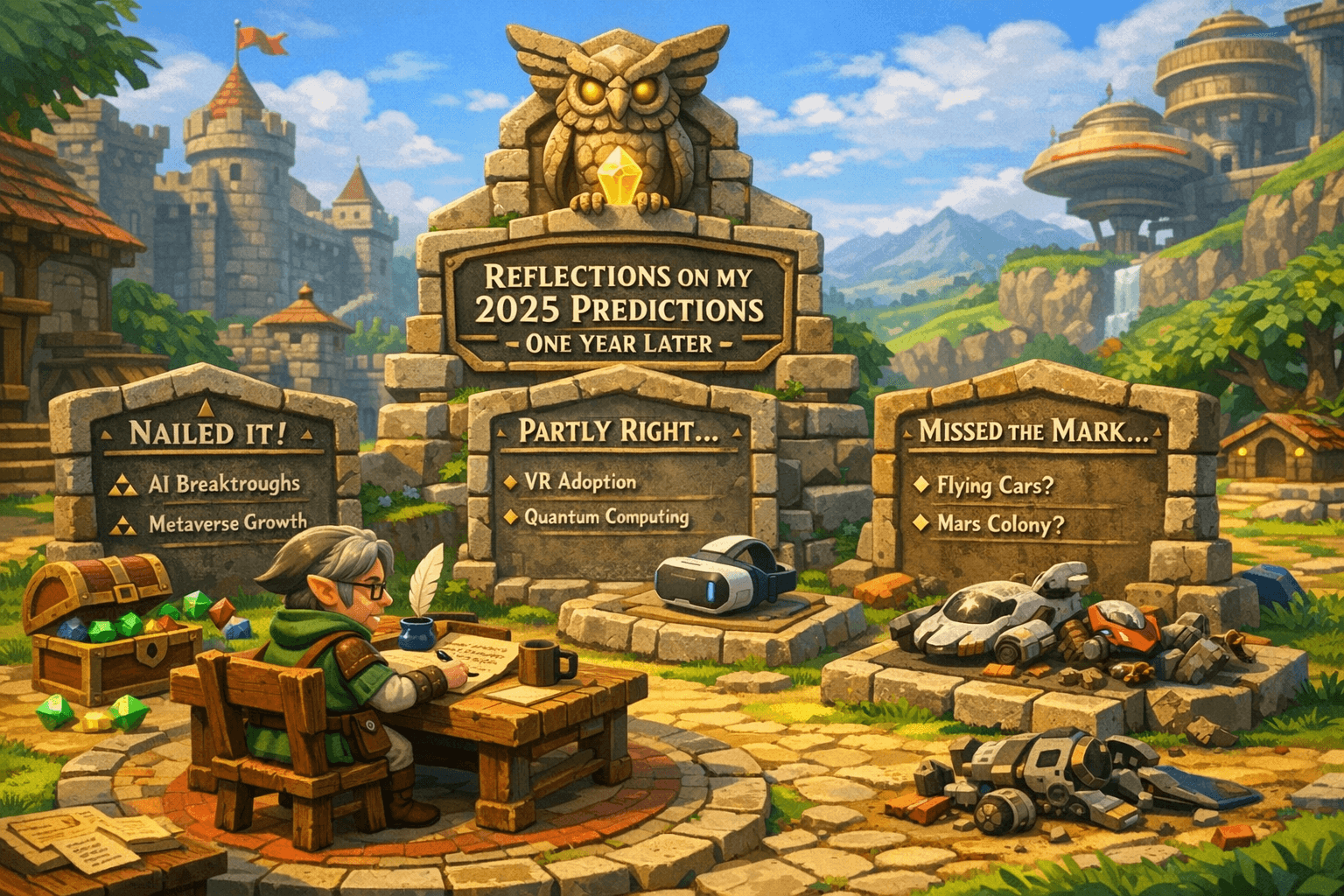
✓ The Wins: Predictions That Hit the Mark
1. LLMs Become Standard Tools for Engineers ✓
The Prediction: LLMs would become a "must-have" tool in every engineer's toolbox without replacing software engineers.
What Actually Happened:
This one came true in spades. In 2025, we saw LLMs embedded everywhere:
- IDE integrations (VS Code, JetBrains) with AI code assistants became routine
- Engineering teams standardized LLM assisted code review and test generation
- Even mid-sized companies adopted LLM automation in documentation and CI workflows
- Tools like Cursor, Claude Code, and GitHub Copilot became as common as debuggers

Why It Succeeded:
LLMs matured quickly in quality and ease of integration. Toolmakers lowered barriers, meaning even small teams could embed AI helpers without vast infrastructure. More importantly, engineers realized these tools augmented rather than replaced their expertise perfect for handling boilerplate while they focused on architecture and complex problems.
Verdict: Fully true. This was my most accurate prediction.
2. Infrastructure (DevOps/MLOps) Becomes Central ✓
The Prediction: Infrastructure related roles would become even more critical as AI workloads demanded robust compute and specialized expertise.
What Actually Happened:
Across companies of all sizes:
- MLOps roles expanded significantly with dedicated teams forming at mid size companies
- Internal data platforms and on prem solutions became strategic investments (not just cloud-first)
- Teams built robust forecasting, deployment, and observability pipelines around AI systems
- Major cloud providers (AWS, GCP, Azure) all launched specialized AI infrastructure services
Why It Succeeded:
AI isn't just experimentation anymore it's production workload at scale. Companies learned the hard way that without solid ops infrastructure, AI models fail silently, drift unpredictably, and become unmaintainable. The "move fast and break things" mentality hit reality: production AI systems need rock solid DevOps foundations and safeguards.
Verdict: True as Infrastructure became the most crucial point for LLMs and AI systems in general.
3. VC Funding Shifts to Hardware / "AI-Proof" Tech ✓
The Prediction: VCs would increasingly fund startups focused on hardware or "AI-proof" technologies where AI hasn't fully penetrated.
What Actually Happened:
The data confirmed the trend:
- Capital began rotating out of software only AI into specialized silicon, robotics startups, and edge compute hardware
- A significant number of Series A/B deals in 2025 prioritized domain specific tech rather than general LLM applications
- Hardware focused accelerators and incubators saw increased participation
- Custom chip design startups (ASICs for specific AI workloads) attracted major funding rounds
Why It Happened:
Software AI is maturing quickly; investors recognized that competitive advantage in pure software AI was easily copied. The real moat lies in specialized hardware, physics constrained problems, and integration challenges that require deep technical expertise. Plus, after the initial AI hype cycle, VCs sought differentiated bets.
Verdict: True. The smart money moved to where AI can't easily compete or is not heavily implemented.
4. Defense Sector Growth Due to Tech + Geopolitics ✓
The Prediction: Defense and military sectors would continue their boom, driven by global tensions and tech advancements in unmanned systems.
What Actually Happened:
Defense spending rose significantly in many regions:
- Increased investment in autonomous ground and aerial vehicles
(drones, UAVs, USVs, UUVs — currently at the edge of evolution)
See examples:- Submarine Guys – Mine Depth (YouTube)
- BlueROV2 – Blue Robotics
- Anduril SeaPower
Many more startups are emerging in this space, especially in autonomous underwater systems. (As I said last year, the best book to read on how the war would look in the future is: The Kill Chain: Defending America in the Future of High-Tech Warfare by Christian Brose)
- AI augmented logistics and supply chain systems became military priorities
- Cybersecurity infrastructure saw massive government contracts
- Countries accelerated modernization programs, particularly in the US, EU, and Asia Pacific
Why It Succeeded:
Ongoing geopolitical tensions and accelerated tech adoption converged perfectly. Nations invested heavily in advanced systems, viewing technological superiority as essential to modern defense. The intersection of AI, UVs, and embedded systems created exactly the boom I predicted.
Verdict: True. Geopolitics and technology trends aligned precisely.
◐ The Partial Hits: Close But Not Quite
5. Niche AI Agents and Task Specific Tools ◐
The Prediction: AI driven agents would evolve into specialized tools tackling very specific tasks across industries.
What Actually Happened:
We did see growth, but with an important evolution:
- Instead of autonomous agents replacing roles, AI plugins and copilots were embedded into existing tools
- GitHub Copilot extensions, ChatOps assistants, and IDE integrations proliferated
- Fully autonomous agents remained novel rather than mainstream automation
- Most "agents" turned out to be sophisticated chatbots or workflow automation, not truly autonomous
- A lot of successful companies exist in this space like ResolveAI, for example, raised $125M to deliver AI-driven incident resolution
Why It Only Partially Hit:
Enterprises prefer controlled AI augmentation over agents that act independently on critical systems. Regulatory concerns, liability questions, and trust issues slowed adoption of truly autonomous agents. Companies wanted humans in the loop augmentation, not automation.
Verdict: Partially true. The spirit was right, but the implementation looked different and adoption was slower than I expected.
6. Humanoid Robots Gain Industrial Traction ◐
The Prediction: Humanoid robotics would begin penetrating the industrial market in practical ways, delivering ROI rather than viral demos.
What Actually Happened:
There's been real progress:
- Multiple pilot deployments in logistics and warehouses (Amazon, DHL trials)
- Some factories trialing humanoids for simple repetitive tasks
- Boston Dynamics, Figure AI, and Tesla's Optimus showed promising demonstrations
But the wide industrial shift I implied hasn't fully arrived yet.
Why It Only Partially Hit:
Hardware reliability, safety certification, and cost per robot still lag expectations. Companies adopted robots, but mainly specialized, non humanoid types. Humanoids face challenges being general purpose but not as efficient as specialized machines for specific tasks. The ROI calculation doesn't favor humanoids yet.
Verdict: Partial. Real deployments happened, but limited scale. Give it another 2-3 years.
7. Database and SaaS Tooling Advanced ◐
The Prediction: Database tools and SaaS platforms would evolve rapidly with automation, speed, and intelligent data handling.
What Actually Happened:
Databases and SaaS tools improved across the board:
- Automation, performance optimizations, and analytics dashboards got better
- ClickHouse, TileDB, and other specialized databases gained adoption
- Security features improved with AI driven threat detection
However, the transformation wasn't revolutionary more incremental.
Why It Lagged My Expectation:
The database and enterprise SaaS space is constrained by legacy systems and enterprise lock in. Innovation trickles in slowly compared to consumer AI services because migration costs are enormous and backwards compatibility is mandatory.
Verdict: True, but less dramatic than I predicted. Evolution, not revolution.
8. Crypto Sees Renewed Growth ◐
The Prediction: Cryptocurrency would experience another surge due to geopolitical uncertainty and a more receptive US administration.
What Actually Happened:
There's been renewed interest in crypto and some new blockchain use cases, but not a blow out boom like 2017 or 2021:
- Regulatory clarity in some regions helped tokenization platforms and utility NFTs
- Bitcoin remained relatively stable, acting more as "digital gold" than a speculative asset(still too volatile though in my opinion)
- Institutional adoption continued at a measured pace
- Speculation cooled; fundamentals and actual use cases mattered more
Why It's Mixed:
Market maturity and macroeconomic headwinds meant crypto growth was steady but not explosive. The wild speculation days seem to be over, crypto is becoming a boring financial instrument.
Verdict: Partial. Growth happened, but not the boom I expected.
✗ The Misses: Where I Got It Wrong
9. Big Tech Layoffs Continue ✗
The Prediction: The wave of layoffs in Big Tech would persist as companies leaned into AI for cost savings.
What Actually Happened:
I expected layoffs to persist strongly through 2025, but they actually slowed in late 2025 and into 2026:
- Some big companies stabilized hiring, especially in AI/ML and infrastructure teams
- Google, Meta, and Amazon started selectively hiring again in strategic areas
- The talent war reignited for specialized AI engineers and infrastructure experts
- Layoffs happened, but not at the scale of 2022-2024
Why This Missed:
After earlier waves, businesses realized skill shortages around AI and engineering infrastructure were becoming bottlenecks. Companies over corrected in their layoffs and found themselves understaffed for their AI ambitions.
Verdict: Not as true as predicted. I was too pessimistic on employment trends.
10. Demand for Embedded Software Engineers Explodes ✗
The Prediction: Embedded software engineering would experience a boom as hardware centric solutions and IoT became integral to AI driven systems.
What Actually Happened:
I expected a big uptick in embedded systems and low-level engineering jobs tied to IoT/AI hardware growth. In reality:
- Embedded demand exists and grew, but not at the explosive pace I anticipated
- Most AI + robotics growth still leans on higher-level software rather than hardcore embedded C/C++/Rust
- IoT projects progressed slower than expected due to security concerns and fragmented standards
- The barrier to entry for embedded work remains high, limiting the talent pool growth
Why This Underperformed:
Supply chains and product cycles for hardware slowed down post COVID. Startups focused more on software first and cloud first AI rather than tight embedded hardware stacks because software iteration is faster and cheaper.
Verdict: Overestimated significantly. I let my enthusiasm for hardware bias my prediction.
Final Thoughts
Making predictions is humbling. I got some right, some partially right, and some completely wrong. But the exercise was valuable it forced me to articulate my mental models and now I can refine them.
The biggest surprise? Infrastructure mattered more than I expected, and hardware moved slower than I hoped. The future is coming, but it's coming at hardware and deep tech speed, not pure software speed.
What are your thoughts? Did I miss anything major from 2025? What do you think will happen in 2026?
Disclaimer:
This reflection is based on publicly available information and my personal observations. Predictions are inherently uncertain, and this analysis is meant for informational and entertainment purposes. I did not receive any money or incentives for mentioning the sites and tools referenced in this article.